















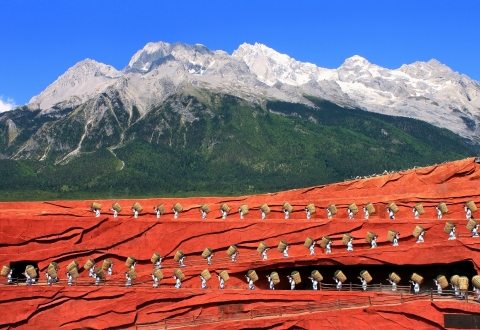
Often the essential route for a first travel to explore Yunnan: Kunming – Dali – Shaxi – Lijiang – Shangrila
Enter Kunming, the modern capital city of China’s southern Yunnan province. Thereafter, be ready to discover a very tempting adventure to the north part of the province and its rich landscapes with different minorities: Bai in Dali, Naxi in Lijiang then Tibetan in Shangrila. Different kind of civil and religious architectures will follow one another, with beautiful and varied landscapes in the background, from Lake Erhai to Tibetan country sides and many more.
Arrival in Kunming by air
After airport formalities, meet your guide and be transferred to hotel.
Serving as the capital of Yunnan, Kunming is historically and culturally renowned throughout the country. It is the center of politics, economy, culture, science and technology in Yunnan. With an annual average temperature of 15 degrees Celsius, it is well known as the City of Eternal Spring without bitter cold in winter and intense heat in summer.
Dinner at leisure – on your own account
Overnight in Kunming, 02 nights
Breakfast at hotel.
Today, we take an excursion to visit the Stone Forest.
An extremely rare geological phenomenon dating back to 270 million years ago, the Stone Forest is 80 hectares of karst limestone pillars in fantastic shapes that resemble a forest viewed from a distance some 85 kilometers, or 2 hour ride, southeast of Kunming. The Stone Forest is also home to the Sani tribe, a branch of the diverse and scattered Yi minority renowned for their diligence, embroidery and dancing.
Back to Kunming to visit the Yuan Tong Temple.
Situated by the Green Lake, Yuan Tong Temple traces back to the Tang Dynasty some 1200 years ago and is currently the biggest Buddhist complex in Kunming.
Lunch en tour at local Chinese restaurant. Dinner at leisure – on your own account
Breakfast at hotel.
Transfer to Kunming Railway Station for bullet train Kunming-Dali (about 2 hours, 2nd class seats).
Standing against the Cangshan Mountains in the west and adjoining the Erhai Lake in the east, embraced by undulating hills around, Dali was the capital of Nanzhao and Dali Kingdom as early as 1,300 years ago. It is home to Bai minority.
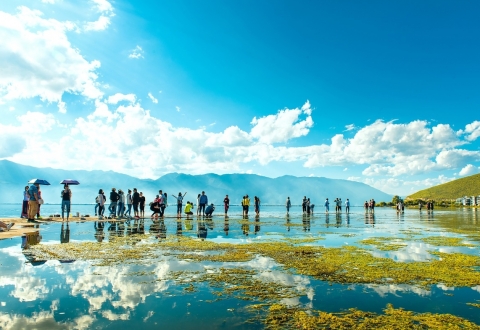
Meet at Dali Railway Station and transfer to the starting point of the Erhai Lake Eco Corridor, where we will take a shared battery cart journey along the Corridor (about 12 kilometers, or 50 minutes) to the terminal at Caicun. The Erhai Lake Eco Corridor is a 27.5-kilometer well-paved road on the west bank of the Erhai Lake. En route, we may see beautiful landscape of the Cangshan Mountains on your left-hand side, and the tranquil Erhai Lake on your right. If you would like to walk for a while, you may get off the cart 2 or 3 kilometers from the Terminal and walk the very last section of the Corridor, with opportunities to visit authentic Bai minority villages.
Continue to visit the Three Pagodas. Standing in a way of a tripod on the outskirts of old town, the Three Pagodas were constructed in about 850 and 1050 following the model of the Small Wild Goose Pagoda in Xi’an. For centuries, they are considered landmark of the region.
Rest of afternoon will be guided stroll in the old town of Dali.
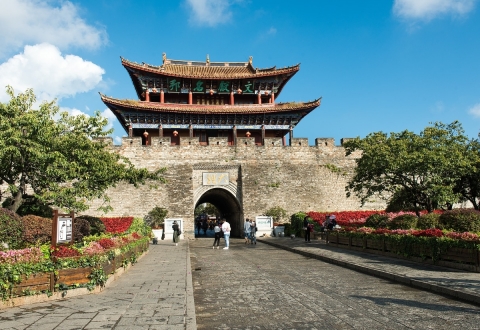
The old town of weathered gray granite stands at 2,100 meters on a long, narrow rice plain between the Cangshan Mountains and the Erhai Lake, a natural configuration that seems specially designed for a good, bountiful life. Format of the old town is like a chessboard with four gates guarding in the directions of east, south, west and north, a design that was adopted by most towns in ancient China.
Lunch en tour at local Chinese restaurant. Dinner at leisure - on your own account
Overnight in Dali, 01 night
Breakfast at hotel.
In the morning, visit the Bai minority village Xizhou.
23 kilometers north of Dali, Xizhou village has a more mixed population and cosmopolitan background. It grew and flourished in the Ming Dynasty (1368-1644) along with the fortunes of Dali’s renowned tea merchants that traded to Tibet. Family Yan’s courtyard is a good example of traditional Bai houses. Here, we will also enjoy Three-coursed Tea accompanied with folk song and dance performance, a ceremony of the Bai people to greet guests.
Then, overland drive of 2 hours to the Shibaoshan Mountains (also known as Stone Treasure Mountains). Visit the Baoxiang Temple that is built along a sheer cliff, and the Stone Bell Temple.
Shibaoshan is hidden in a remote mountain region in Jianchuang County. Apart from fine depictions of Buddhist deities and disciples, the grottoes at Stone Bell Temple are outstanding for their presentation of life under the Nanzhao Kingdom (748-902). The works are entirely carvings, with no frescoes. Two lesser sites within Shibaoshan region, namely Lion’s Pass and Shadeng Valley. Artistic accomplishment of Shibaoshan grottoes are regarded by scholars the best one in the entire South China.
From a well paved trail behind the Stone Bell Temple, we will trek downhill, along the Shadeng Valley, to the Sideng Village of Shaxi Township. The hike is about 1.5 hour and we may see quite a few grottoes along the trail.
Sideng village, residing in the immediate neighborhood of Shibaoshan and under the jurisdiction of Shaxi Township, was a prosperous town on the old South China Silk Road that connects China with South Asia, Southeast Asia and West Asia. Traditional Bai houses line up to form the village a chessboard. The century-old Xingjiao Buddhist Temple and wooden theater worth a visit. Sideng village was enlisted as one of the 101 World Monumental Constructions in late 2001 by World Monumental Construction Fund.
Lunch en tour at local Chinese restaurant. Dinner at leisure - on your own account
Overnight at Shaxi, 01 night
Breakfast at hotel.
In the morning, take a guided stroll in Sideng Village to the market square, the Xingjiao Buddhist Temple, and old residences of former caravan leaders.
Then, overland drive of 2 hours to Lijiang.
A gathering place of rugged mountain people with the Naxi forming the majority, Lijiang is a small mountain town of stone and tile, laced with swift canals, which has been recently listed as an UNESCO world monument.
After check in at hotel, take a guided stroll in the old town, where you will climb up to the Lion Hill to visit the Wangu Pavilion and bird-eye view of the old town. Ascending the Pavilion, you may take fine pictures of the old town quarter.
Old town of Lijiang is a big area with its center, or Si Fang Jie (Square Street) in the form of an official ink stone, hence its name Dayan (ink stone) Town. It enjoys a long history of over 800 years and unlike most of the old towns in China, there is no city alls due to a superstitious belief of the local ruler whose family name is Mu (tree), when encircled by walls, would be Kun (besieged). Wooden structures, mountains, small rivers and lanes integrate harmoniously in this mountain town.
Visit also to the Black Dragon Pond with the Wufeng Temple (Five Phoenix Pavilion) and Dongba Cultural Museum. The Pond provides you opportunity of taking great pictures of the crystal clear pond with backdrop of snow mountains in a distance.
Lunch en tour at local Chinese restaurant. Dinner at leisure – on your own account
Overnight in Lijiang, 02 nights
Breakfast at hotel.
We will take a first visit of the old town to the Zhong Yi market, where we may see vegetables freshly harvested from fields and quite a few copperwares.
Then, drive out to visit the Yak Meadow of the Jade Dragon Snow Mountains. Take chairlift (roundtrip) ride up with superb views over the mountains and valleys. Good weather permitting, you will be able to see the much-famed snow-clad thirteen peaks.
On the way back to Lijiang, visit the Naxi minority village Yuhu and Baisha.
Yuhu is a simple village of Naxi minority with the former residence of Dr. Joseph Rock. Dr. Rock, an Austro-American botanist and explorer who lived here off and on from 1922-1949, is best remembered for the introduction of innumerable plant species to the West and his rigorous works on Naxi ethnology.
North of Lijiang Country finds the Liulidian Temple and Daobaoji Temple at Baisha village, housing 558 mural paintings on 12 walls that date back to the Ming Dynasty in 1385. Buddhism, Taoism and Lamaism manifest in integration in styles of the Han Chinese, the Tibetan, the Bai and the Naxi people on the murals, a proof of exchange on politics, economy, culture and religion between the mainland and the frontiers of China. They are now rated as key cultural relics under national protection.
Lunch en tour at local Chinese restaurant. Dinner at leisure – on your own account
Breakfast at hotel.
Today, overland drive of around 200 kilometers, or 4 hours, along the Yunnan-Tibet road to Zhongdian.
En route, we will take stops to visit the First Bend of the Yangzi River and the Tiger Leaping Gorge.
The village of Stone Drum stands at the First Bend of the Yangzi River, some 70 kilometers west of Lijiang. Approaching to Stone Drum offers a dramatic view of the Yangzi's near-180-degree turn, where the wide, swift waters perform a miraculous about-face. For nearly 20 kilometers the river, first flowing south, then north, runs parallel to itself. Locals say if it were not for their village standing guard at the bend, China would lose the water of the Yangzi to Southeast Asia, like that of the adjacent Mekong and Salween Rivers.
The Tiger Leaping Gorge, or Hutiaoxia in Chinese, is the Yangzi's best-known gorge after the Three Gorges in Sichuan and Hubei. Wedged tightly between titanic cliffs, the river is so narrow here, as legend tells us, that a hunted tiger made his escape to the other side in a single bound. Here, the Jade Dragon Snow Mountains and the Haba Snow Mountains lean close to each other and a large volume of torrent moving between them cutting deeper and deeper into the bottom of the gorge. In some places there is a drop of 3,000 meters to the water.
At 3,160 meters above sea level, Shangri-La (or Gyalthang in Tibetan, also known as Zhongdian, was approved by State Council to be renamed Shangri-La County as of late December 2001) lies in a landscape of rolling hills, snow-capped peaks, virgin forests of spruce, pine and meadow dotted with wild flowers and tranquil lakes. The old town, still entirely in local Tibetan style, is to the south of Zhongdian.
Lunch en route at local Chinese restaurant. Dinner at leisure – on your own account
Overnight in Zhongdian, 03 nights
Breakfast at hotel.
Today, we take an excursion to visit the Shudu Lake in the Pu Da Cuo National Park. You may walk long the wooden plank way about 3.3 kilometers in the park to enjoy tranquil scenery of this alpine lake.
Shudu, or where milk gathers in Tibetan, is one of the biggest plateau lakes in Zhongdian. It is situated 35 kilometers in the northeast of the county proper with an elevation of 3705 meters. The Lake is surrounded with deep primeval forests of fir and dragon spruce. The silver birch covering the eastern part of the Lake turns to golden yellow in autumn, providing very photogenic scenes. The natural grassland around the Lake is the best pasture in Zhongdian. At the turn of spring and summer, we may have pastoral scenes of the Lake with herds of sheep and cattle.
Then, take a guided stroll in the Old Town, and climb up the Guishan Hill to visit the great prayer wheel and take a panoramic view of the old town quarter.
Lunch en tour at local Chinese restaurant. Dinner at leisure – on your own account
Breakfast at hotel.
In the morning, visit the Ganden Songzanglin Monastery.
Founded in the 17th century during the reign of the Great Fifth Dalai Lama and nicknamed as Lesser Potala Palace by the locals, Ganden Songzanglin Monastery is one of the thirteen Tibetan monasteries in the Kangba Region, where Tibet, Yunnan and Sichuan join. Holding about 700 monks and one living Buddha, the monastery is a must-go in the region.
In the afternoon, drive out to visit the black pottery workshop at Tibetan village Nixi. The handmade black earthenware is decorated with broken pieces of white china.
With a population of 112 thousand people, the Tibetan minority takes up one third of the total in Diqing Tibetan Autonomous Prefecture. They believe in Lamaism, a major branch of Buddhism. During the new year on Tibetan calendar and the horse racing festival on the fifth day of the fifth month on Chinese lunar calendar, there are big gatherings of Tibetans in Zhongdian, Deqin and Weixi celebrating the festivals.
Lunch en tour at local Chinese restaurant. Dinner at leisure – on your own account
Breakfast at hotel.
Transfer to Shangri-La Airport for your onward flight.
- Price is per person / sharing double/twin room
- Price is for land arrangements only
- Price is subject to change without prior notice. Terms and Conditions Apply
- Price is subject to availability and confirmation at the time of booking.
- INTERNATIONAL FLIGHTS ARE NOT INCLUDED (can be quoted and arranged separately)
Inclusive of:
~ 02 nights stay at Hotel in Kunming with breakfast
~ 01 night stay at Hotel in Dali with breakfast
~ 01 night stay at Courtyard in Shaxi with breakfast
~ 02 nights stay at Hotel in Lijiang with breakfast
~ 03 nights stay at Hotel in Shangrila / Zhongdian with breakfast
~ All sightseeing tour with the service of private / local English speaking tour guide as per itinerary
~ All entrance fees to scenic sites as per itinerary
~ All lunches at local Chinese restaurant as per itinerary. (8 lunch in all)
~ All transportation in a private air-conditioned vehicle with experienced driver as per itinerary
~ Bullet train ticket: Kunming – Dali on Second Class.
~ Dali Old Town Tax and Lijiang Old Town Tax
Remarks:
~ CHINA VISA IS REQUIRED
~ Prices are subject to change without notice and are subject to availability and confirmation at the time of booking.
~ Package prices are subject to additional high season surcharge during Easter, summer holiday, weekends, public holidays, event period, Christmas and Chinese New Year.
For inquiries and bookings
please email us INFO@F56.COM or call us +852 2521 0571