














Vessel: MS SPLITSBERGEN
Departure Date: 20 Apr 2021.
- Visit the Shetland Islands, Orkney Islands, and Inner and Outer Hebrides
- Learn the history of the Scottish clans as we explore ancient abbeys and castles
- Enjoy a private visit of Duart Castle on the Isle of Mull hosted by the clan chief
- Engage in bird and wildlife spotting throughout, especially in St. Kilda and Fair Isle

Visit the fish market and stroll through Bergen´s historic harbor area, fronted by wooden houses dating back as far as the 1300s. You can also take a trip up nearby Mount Fløyen via funicular tram. Enjoy views over the city and surrounding mountains, and even spot your expedition ship, MS Spitsbergen, docked below.
Lerwick is the main port of the Shetland Islands, and by far the northernmost town in Scotland. Founded in the 17th century as a fishing port, Lerwick today is a bustling, cosmopolitan town. The old waterfront is still active with visiting yachts and working fishing boats. The area boasts some of Shetland's most attractive scenery and an extraordinary concentration of archaeological sites, including two remarkable Iron Age villages.
Lonely Fair Isle has high red-sandstone cliffs and gentle rolling fields and is vital stop for migrating birds. A permanent bird observatory was established here in 1948. Synonymous with unique geometric knitwear, possibly of Spanish or Scandinavian origin, the island also boasts a mini “Lighthouse Keepers” golf course, as well as a friendly, self-reliant population.
Kirkwall is the largest town and capital of the Orkney Islands. The first mention of a settlement here is in a saga from 1046, and the name Kirkwall derives from the Old Norse “Kirkjuvagr” (Church Bay). Today, Kirkwall has a population of 8,500, and is one of the most attractive and well-preserved small towns in Scotland The community is dominated by the famous St. Magnus Cathedral. A local saga tells the story of how Magnus, kidnapped from the islands, refused to fight with the Vikings or condone their violence. Magnus eventually returned home, only to be put to death for his pacifism, and the church was named in his memory.
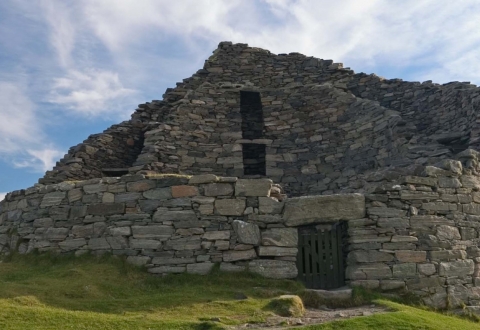
Originally a Viking settlement, Stornoway is the main town of the Western Isles and the capital of the Isle of Lewis & Harris, which is the largest and most northerly of the Outer Hebrides. A bustling harbor and waterfront with museums and art galleries is overlooked by the handsome Lews Castle, which we invite you to explore with us. Further afield are mills and cottages where durable Harris Tweeds are woven. Discover tiny folk museums, the world-famous Callanish Standing Stones, and the mysterious Carloway Broch - the best preserved fort in Scotland dating back more than 2,000 years.
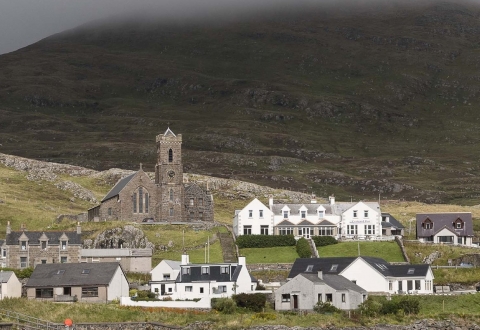
Any visit to this distant and wild archipelago, with its breathtaking sea cliffs, is totally weather-dependent. As a UNESCO double World Heritage site and “jewel in the crown” of the National Trust for Scotland, it is an unforgettable experience. The outlying sea stacks and islands, the remains of a volcanic crater, provide ledges for thousands of nesting seabirds. Minke whales are frequently seen in the swirling waters around the archipelago.
Once home to Britain’s most remote island community, it was evacuated in 1930 at the islanders’ own request after 5,000 years of continuous habitation. The tiny museum that remains is a record of how hard life was on this exposed island.
Once a prosperous herring port, Castlebay is dominated by the romantic medieval fortress of Kisimul Castle, acquired by Clan MacNeil as a reward for fighting with Robert the Bruce at Banockburn. The rugged interior of Castlebay is ringed by scenic beaches and is the inspiration for many artists and writers, as well as providing delightful walking and kayaking. We spend the morning exploring Castlebay before heading to the Isle of Rum later in the day.
The wildlife haven on Rum is a nature reserve and research center. The island was once the sporting estate for Lancashire cotton magnate, Sir George Bullough. He built Kinlock, an Edwardian era castle that remains a time-capsule of Edwardian grandeur, complete with French silk wallpaper, antiques and atmospheric rooms. Otters are regularly seen around the island’s shores, and there is a large population of red deer.
Known as the “Gateway to the Isles,” the little town of Oban reached its heyday when the railway arrived, adding to its life as a busy fishing port. Now a popular holiday spot, Victorian buildings cluster round the port, ferries come and go, heading out to the distant Hebrides. Many cafés have seafood-focused menus, and the distillery provides tours to sample a local dram of whisky.
This evening, we visit Craignure where we are fortunate to have a private guided visit to the dramatic 800-year-old Duart Castle, one of very few remaining in the ownership of the original family. We will be met by Sir Lachlan MacLean, the clan chief himself. The castle houses much MacLean memorabilia and our visit will include the kitchen, sea room and Edwardian bedrooms, as well as a private reception in the banquet hall. The castle is very much the type of building you would expect a highland chief to live in - simply furnished, austere and exuding an air of venerable durability.
Home to over 200 bird species, including the rare and elusive corncrake, Colonsay is a gentle island with woods and pretty beaches, like Kiloran Bay. The village of Scalasaig is the island’s main settlement. Colonsay House is home to exotic gardens, and the surrounding woods, moors and fields have over 400 species of flora. The island offers easy walking and kayaking in the surrounding waters.
Once the seat of the MacDonalds, Lords of the Isles, this is “whisky island,” world renowned for its peaty single malt whiskies and many distilleries. A stop-off for wintering geese and migrating birds, Islay offers good bird spotting. In the charming little town of Bowmore, there are a handful of small shops, an interesting round church with no corners, plus superb cliff-top walks and a well-known golf course.
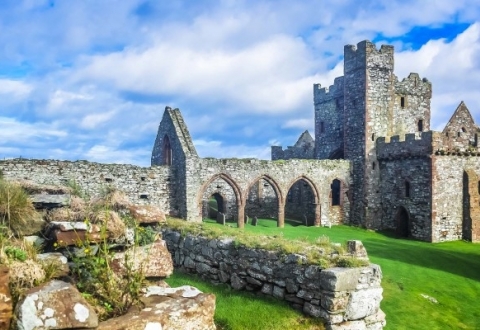
A seaside town, the pretty port of Peel was the 14th century capital and seat to the King of Mann. Winding lanes of merchants’ houses bear witness to the 19th century fishing schooners built here and that traded from Ireland to Shetland. Peel Castle, connected by causeway and reputedly built by Magnus Barelegs, King of Norway, dates from the 11th century. Museums in town display vintage bikes and cars, a direct connection to the modern-day high-speed racing scene on the island.
A city of industry and elegance, Belfast is the birthplace of the Titanic, as well as the capital and largest city of Northern Ireland. It is the gateway to a glorious countryside of pretty villages and beautiful rugged coastline with pristine beaches and breathtaking cliff-top walks. Experience Giants Causeway, hike through spectacular scenery or explore what impressive Belfast has to offer.
Our voyage ends in Glasgow (Greenock), which means “Dear Green Place” in Gaelic. Glasgow boasts over 90 parks and gardens, is famous for its Victorian and art nouveau architecture, and is home to such institutions as the Scottish Ballet, Opera and National Theatre. This is definitely a city you’ll want to explore more of before you head home.
MS Spitsbergen is named after the crown jewel of Arctic Norway – the Svalbard archipelago and its biggest island, Spitsbergen. Hurtigruten has a long history of travelling to Spitsbergen, beginning in 1896 with the `Sports Route´. MS Spitsbergen cruises along the Norwegian coast from September to May, and becomes part of our global Explorer sailings during the rest of the year.
After complete reconstruction, MS Spitsbergen joined the Hurtigruten fleet in 2016. The ship features high technical standards as well as comfortable, modern public areas and cabins. The vessel's fresh Scandinavian design reflects a colour palette derived from the sea. She is modern and environmentally progressive, and we plan further improvements that will reduce emissions and fuel consumption even more. The new ship’s maneuverability and optimal size make her quite suitable for exploring polar waters.
